Orthodontic treatment has evolved rapidly over the last decade. With the rise of clear aligners, many people now believe traditional fixed braces are outdated or unnecessary. This is a myth. In real clinical practice, both systems play critical and complementary roles.
This article provides a real-world style case analysis, myth vs fact comparisons, and a professional explanation of why clear aligners are not a universal replacement for fixed braces.
Understanding the Two Systems
Fixed Braces (Traditional Orthodontics)
Fixed braces use brackets and wires attached to teeth to move them precisely in three dimensions. They are continuously active and fully controlled by the orthodontist.
Clear Aligners
Clear aligners are removable, transparent trays that gradually move teeth using a staged digital plan. They are more aesthetic and comfortable but depend heavily on patient compliance and case selection.
Common Myths vs Facts
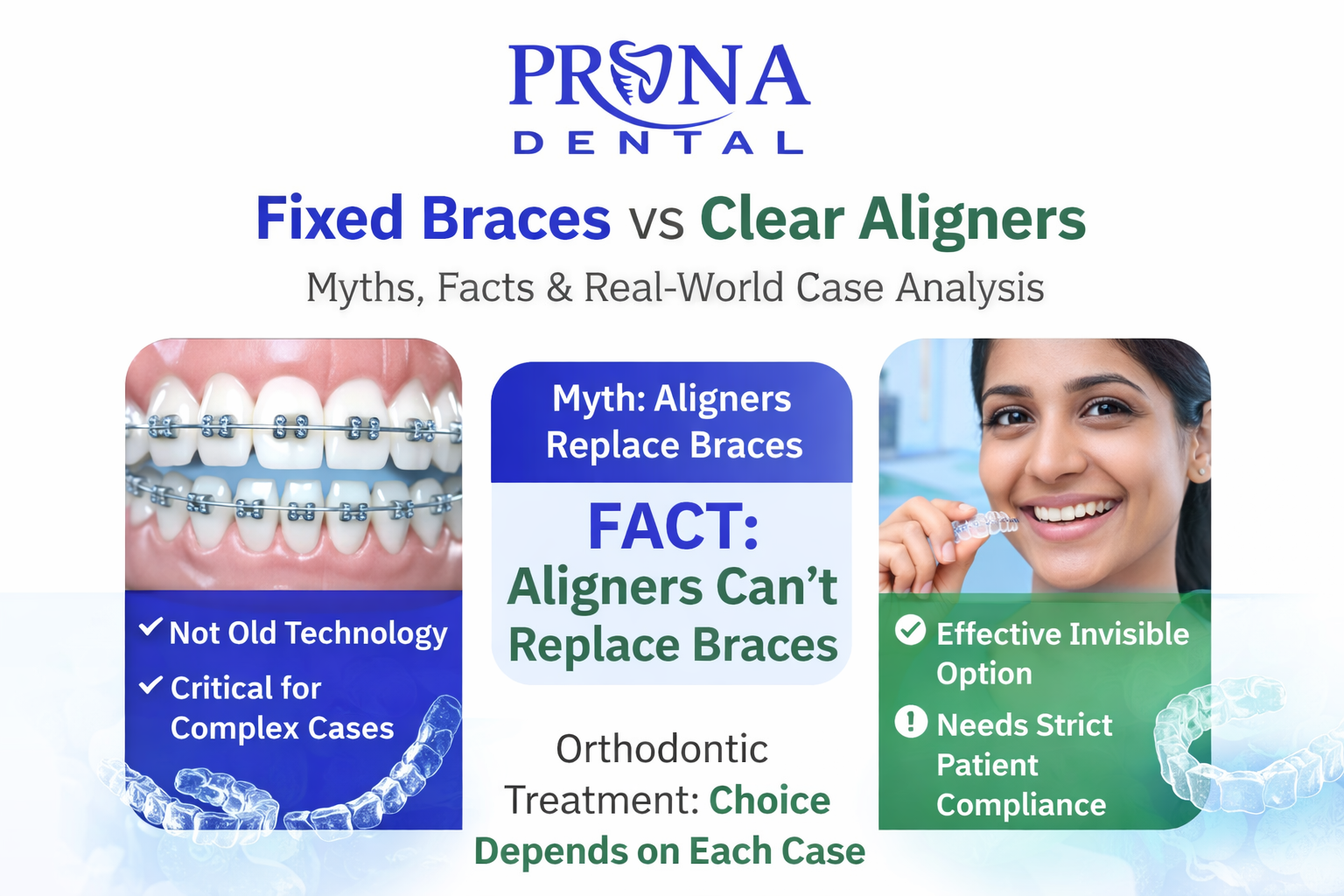
Myth 1: Clear Aligners Can Treat All Orthodontic Problems
Fact: Clear aligners are excellent for mild to moderate alignment issues, but complex cases often respond better to fixed braces.
Complex cases include:
-
Severe crowding
-
Major bite correction
-
Large tooth rotations
-
Vertical tooth movements
-
Jaw relationship problems
In these situations, fixed braces provide stronger mechanical control.
Myth 2: Fixed Braces Are Old Technology
Fact: Fixed orthodontics is continuously improving.
Modern braces now include:
-
Low-profile brackets
-
Ceramic tooth-colored braces
-
Advanced wire materials
-
Faster and more efficient biomechanics
They are not outdated — they are foundational.
Myth 3: Aligners Are Always Faster
Fact: Treatment speed depends on:
-
Case complexity
-
Patient compliance
-
Biology of tooth movement
If aligners are not worn 20–22 hours daily, treatment can become slower than braces.
Myth 4: Aligners Are Always More Comfortable
Fact: Aligners are smoother, but they still create pressure and soreness during each stage change. Attachments and elastics may also be required, reducing the “comfort advantage” in some cases.
Real-World Case Style Analysis (Typical Clinical Scenario)
Case Profile
-
Age: 24
-
Problem: Severe crowding + deep bite
-
Patient preference: Clear aligners only
Initial Plan Attempt with Aligners
Digital simulation showed:
-
Limited rotation control on lower incisors
-
Poor predicted bite correction
-
Need for multiple refinements
Projected aligner stages: Very high
Predicted compliance risk: Moderate
Orthodontist Decision
Switched to fixed braces for:
-
Initial leveling
-
Rotation correction
-
Bite opening
Later phase finished with clear aligners for detailing.
Result
-
Better bite stability
-
More predictable alignment
-
Shorter overall treatment time
-
Improved finishing accuracy
Clinical lesson: Hybrid approach often produces the best real-world results.
Where Clear Aligners Work Best
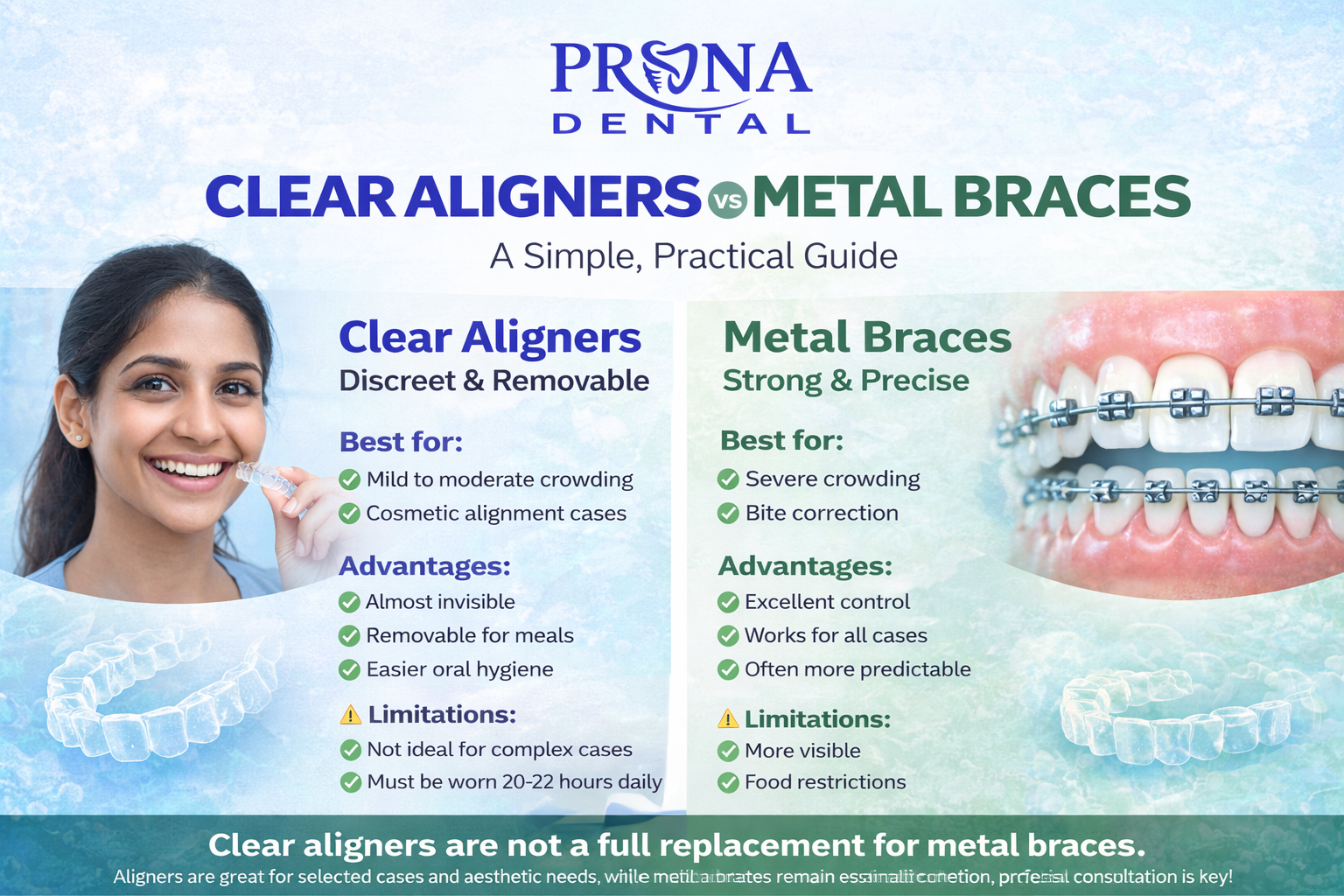
Clear aligners are highly effective for:
✅ Mild to moderate crowding
✅ Minor spacing issues
✅ Cosmetic alignment
✅ Relapse cases after previous braces
✅ Adults wanting discreet treatment
✅ Patients with strong compliance
Where Fixed Braces Are Often Superior
Fixed braces are preferred for:
✅ Severe crowding
✅ Complex rotations
✅ Vertical tooth movement
✅ Major bite correction
✅ Teen cases with compliance risk
✅ Multi-phase orthodontic plans
✅ Cases requiring elastic mechanics
Limitations of Clear Aligners in Practice
-
Requires strict wear time discipline
-
Can be removed too often
-
Attachments reduce invisibility
-
Not ideal for every tooth movement
-
Refinement stages are common
-
Results depend on patient behavior
-
Can be lost or damaged
The Truth: It’s Not Aligners vs Braces — It’s Case Selection
Professional orthodontics is not about trends — it is about biomechanics and biology.
Best outcomes come from:
-
Proper diagnosis
-
X-ray and scan analysis
-
Bite evaluation
-
Movement feasibility
-
Patient lifestyle assessment
Sometimes aligners are best.
Sometimes braces are best.
Sometimes a combined approach is best.
Final Takeaway
Clear aligners are a powerful modern tool — but not a universal replacement for fixed braces. Traditional orthodontics remains essential for many real-world cases.
Choosing the right method should always be based on:
-
Clinical evidence
-
Case complexity
-
Professional evaluation
-
Long-term stability — not just appearance during treatment.